Tuesday, June 8, 2010

Riding the Wave of Functional Strength

For more useful training tips, subscribe to my monthly newsletter!

As you may know, Greg and I had a tough year in the process of trying to build a family. –But most things also being opportunities...we took one for a bit of surfing in Costa Rica!
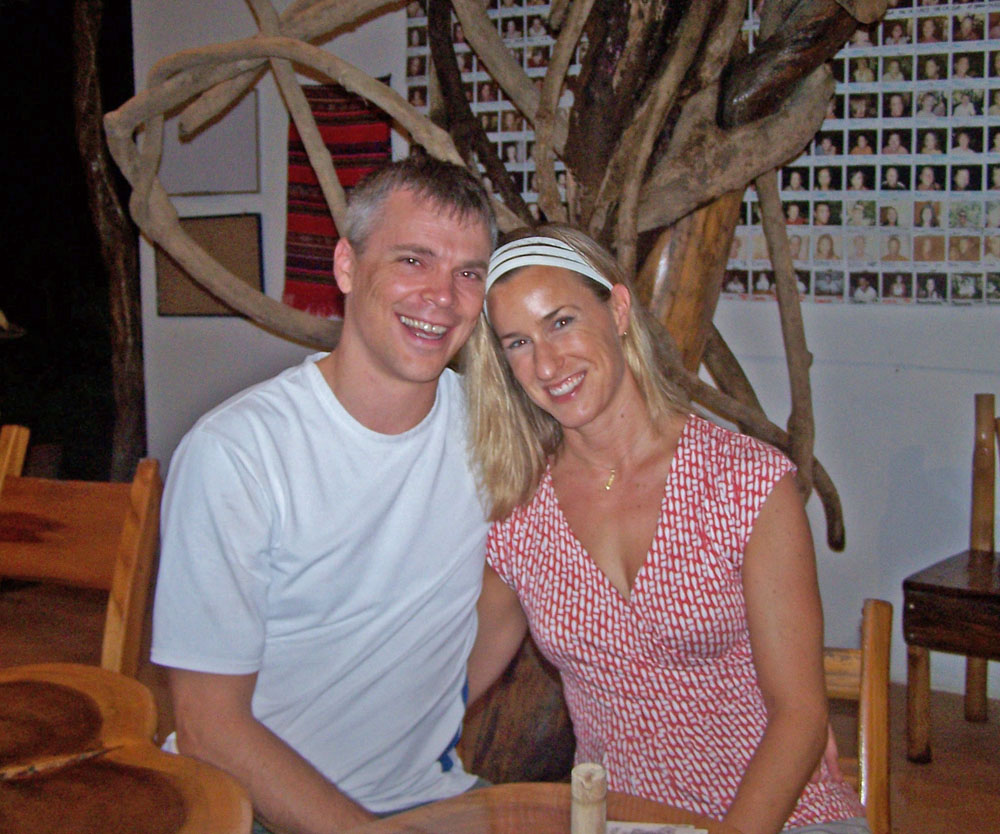

Despite some rain and initially rough conditions, we had an excellent time being there together, and sharing meals with the other guests at the surf hangout.

Each time you take a real vacation, don't you wonder why you don't do it more often? Surfing can be the perfect mental “break” for me (pun intended)! Triathlon is a very structured sport: Do x for y minutes at z intensity. With surfing, it's better if you just let it all go.

Rough conditions meant a LOT of paddling...and some fun waves in the end. The first time I paddled out smoothly through multiple breaks, rip current, and significant churn, fellow surfers Rob and Koto asked how often I normally swim - every day?

Actually, I've averaged only one swim per week over the last several months. But, I also do functional strength training twice a week. While training for triathlons, I make it tri-specific; I switched to a surfing emphasis 2-3 weeks out from our trip.

The result? The ability to surf or swim 1-2 times every day, with no soreness or injury. By the end I had some tired arms...but I'd been able to go for any wave, including many of the bigger waves.

...Now to get my board-riding skills up to par with the paddling ability. I guess we'll just have to go back!

Tuesday, April 20, 2010

D.O.T. Supports Peds and Cyclists!

Secretary Ray LaHood recently has made several public statements to the effect that federally funded road planning will take into account the needs of cyclists and pedestrians.


(From WIRED online) In what amounts to a sea change for the Department of Transportation, the automobile will no longer be the prime consideration in federal transportation planning. Transportation Secretary Ray LaHood says the needs of pedestrians and cyclists will be considered along with those of motorists, and he makes it clear that walking and riding are “an important component for livable communities.”


While it may take time for the results of the new policy to trickle down to our neighborhoods, it's a move in the right direction! Making room for people to ride and walk not only increases safety for everyone on the road; it encourages people to take the active route more often - something this country desperately needs.

Wednesday, March 17, 2010

Beautiful Swimming

So I've been teaching more swim lessons lately, mostly for adults who want to improve their stroke, or are training for a triathlon.


I've never been an NCAA swimming champ myself, but NOT being a natural-born dolphin has motivated me to work even harder through the mechanics of swimming. I've always been comfortable in the water, and started swimming at a very young age. But, I found that the kids who excelled naturally had certain body traits -- very flexible backs, mid-sections and ankles; wide, stable shoulders; sometimes hyper-exenteded knees; and a natural tendency to float.


Olympic swimmer Michael Phelps has been physically analyzed ad nauseum; and sure enough, his physique reflects all of these traits, plus flipper-like hands and feet - the perfect form for moving through water (though not necessarily on land).


So what do you do if you're a natural "sinker," have narrow, hypermobile (unstable) shoulders, a relatively stiff but overly-curved lower back, and bricks for feet? Well, first you work on gaining as much flexibility and stability as possible. Then there's technique, which comprises a HUGE part of comfortable swimming.


Terry Laughlin's Total Immersion program (workshops, books, DVDs) is a fanatastic method for "the rest of us." Terry himself wanted to compete in swimming, but was mediocre at best. ...Until later has was coaching, and really applied his analytical mind to the problem.

In his 50s, Laughlin became an open-water swim champion - able to swim long distances with an amazingly efficient stroke, at record-breaking speeds.

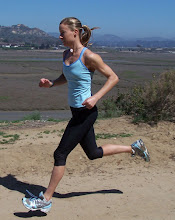
Here's Total Immersion Japan coach Shinji Takeuchi doing TI freestyle with a two-beat kick. (Takeuchi is pictured above.) This is the result of countless hours in the pool, re-creating and perfecting mechanics -- but the result is low-effort, high-efficiency poetry in the water.

Friday, January 22, 2010

Organic Food Makes the Main Aisle!


Have you ever really acheived one-stop grocery shopping? I haven't, which is why I make rounds at Trader Joe's, Henry's, Von's, and occasionally the elite-priced Jimbo's, depending on what I need and where I am that day.

You also may have noticed that it's harder to find and obtain really good, healthy food. It's easy to walk the main aisles of a supermarket, and pick up all the convenient food in pretty boxes, loaded with preservatives, colors, artificial sweetener, flavor, texture, fat substitute, you-name-it. Normally, much of the truly healthy stuff (real food!) is buried along the perimeter of major supermarkets, in hard-to-find spots.

So I'd discovered that Von's had, waaaay in the back behind the produce section, an organic frozen foods section. Score!! The products and their prices befuddled cashiers, who didn't see those items very often. These were healthy - truly, containing no man-made stuff and balanced, good fats - entrees and pockets by Amy's Organics, Cascadian Farms, Cedarlane, etc.

The other day in Von's, I was dismayed to see that whole freezer section EMPTY. Oh no, what happened? Did they banish the real food to a quiet holding cell, to be forever forgotten? Thinking maybe they'd moved things, I went to aisle 7, the center of the store. Lo and behold, the organic foods!

Not only that, but Von's Carlsbad has added new inventory - a small section dedicated to frozen, non-dairy desserts, and a few all-natural dairy items.

Hallelujah! This feels like some kind of small but noticeable forward progress...

BTW, Amy's whole-grain sandwich pockets are perfect with a high-protein smoothie. If you don't have time to make your own, try Naked Juice's Protein Zone, or Odwalla's Protein Monster. Often there are 2-for-1 or club deals in stores - stock up then!

Thursday, January 7, 2010

Getting Perspective on The Biggest Loser

The hit reality show The Biggest Loser has entertainment value. And it motivates people to exercise. That's two great things already!


But, while you enjoy watching other people sweat off the pounds by the minute, keep in mind that entertainment does not equal reality.


Here's what's unrealistic (and even risky) about the show:


  • Lack of workout progression. Overweight contestants do sprints, advanced jumps, or haul another person (ALERT - potential back injury!). While this is what we see, the show's producers say that contestants undergo an adaptation phase first. Great!

    The problem is that we only see a subset of the actual training that happens. The average viewer might think he should also start by sprinting across the gym with his friend on his back.


  • Unrealistic time allocation. This is TV, so contestants get to work out with trainers for hours each day. First, it's not realistic for most people. Second, this much exercise all at once is a recipe for burnout. It's like 1980s "crash training" - your body just can't keep it up, so you're more likely to lose gains quickly when you become exhausted after a few weeks or months. It's also more conducive to repetitive-stress injury.


  • Extreme exercise selection. Again, this is TV. Some exercises are extreme, dangerous, silly, or just unnecessary. My concern is that this makes viewers think they have to do "extreme" things to get and stay fit. The most effective path to permanent weight loss is a consistent but varied routine of activities you can do correctly.


  • Overly-rapid weight loss. The contestants work out a lot, and hard! They also start out with a LOT of extra weight. Generally, weight loss is "reverse exponential" - an obese person loses weight more quickly at first; it's much harder to lose the last 5-10 lbs. The show sensationalizes fast, and BIG, weight loss, because it's interesting to watch! --A good case of "Do not try this at home!"

The main point is, just remember it's TV, and it's a partial picture! Then, enjoy the show.

Friday, October 23, 2009

The Work > Recovery Cycle


This is a Q&A I had recently with a local amateur triathlete - on staying healthy while training and stretching your limits. You can't continue working hard over time without recovery!

Q: Just finishing up my first full year of this great sport and I wanted to get some advice from you seasoned athletes. I have never logged so many miles before and I think it gets to me towards the end of my training. The week of wildflower i was sick and now a week before SOMA (half Ironman) I am sick AGAIN!! Frustating! My main question is the miles I still have go this weekend? Should i just relax? Also, how can I try to avoid getting sick before these events? Thank you very much in advance!!!

A: As you build miles or intensity in your training, pay extra attention to recovery: 10-20g protein right after hard workouts, very nutritious food all the time (whole grains, lean proteins, fruits/vegetables), good fueling during workouts, massage (tennis ball, foam roll and stick if you can’t afford to pay), and LOTS of sleep.

If you don’t have enough time at night to sleep, try 30-45-min. naps after lunch or just after work. Reducing overall caffeine and alcohol intake, and stretching/massaging before bed, enhance sleep quality. Alcohol also temporarily suppresses the immune system, and may slow recovery after intense workouts.

Training is a continual process of adapting to physical stressors, so if the balance between work and recovery is off, you’re likely to get sick as soon as you taper or rest. Simply put, if you’re going to work hard, you must also rest well during your hard training.

Left: 3-time Ironman World Champion Chrissie Wellington, speaking to GOTRIbal women, Oct. 2009. For her, training is 24/7 - eating, sleeping, resting, elevating the legs, massage, physical therapy.

Is there anything in your lifestyle draining your energy? If it’s inadequate sleep, adding 1 hour of sleep/day could make all the difference. If it’s something else, try to identify it and see if you can change it. (For ex. -- I was trying to train while doing immunosuppressant treatments for psoriasis – a dysfunctional imbalance. That was tough to change, b/c it’s a complex problem. But after enough looking and asking experts for help, I found better solutions. If you can’t find the answers yourself, consult a good coach or doctor!)
Re: being sick or immuno-compromised before races -- I found that total rest worked better for me in the 2-3 days before a big race than trying to keep up with remaining workouts.


I hope this helps!

Friday, October 2, 2009

I'm Working Out - Why Am I Not Losing Weight?


Dragging? Frustrated by the tightness of your clothes?

This is a question that I hear frequently. Of course, the answer is not always black and white, as each body is different, and a body changes over time. If you're already avoiding the problems below, you may want to have a full metabolic test done - one that includes a hormone panel.

First, let's focus on body fat, instead of weight. Weight fluctuates hourly, and varies with factors like weather, hormones, and salt intake. Body fat percentage is a better and more accurate way to guage health and fitness levels. A strong, lean body is not only attractive, but burns more energy around the clock.

If your body does not drop fat or weight, even with increased activity, the culprit may be:

Missing meals. If you are not eating at least every 3-4 hours, your body is entering starvation mode between meals. The body does not understand "diet;" it only knows "starvation." It reacts by slowing down your metabolism, and producing powerful brain chemicals that tell you to eat sugar or carbohydrates, quickly! Keep the furnace burning evenly, and keep the calorie burn high.

Cutting too many carbs. Carbohydrates provide muscle glycogen, or fuel for activity. Cutting them shorts you on fuel and energy. If you're active and cutting carbs, your body will go into ALERT mode, and slow down all systems, including metabolism and digestion. After a few weeks, you'll probably start to feel fatigued, and eventually unable to keep up with the workouts. A healthy nutrition plan includes adequate protein, and a moderate amount of carbohydrate from whole-grain foods. If you're an endurance athlete or dancer, add simple carbs during any activity over 1 hour.


Missing protein. Stressing a muscle (working out) tears down its tissue. Protein allows muscle tissue to rebuild after a workout. You can work out all day every day, but if you're short on protein, your body won't show it. How much depends on body weight and activity level and intensity, but a 150-lb., active adult needs 105 grams per day.


Under-hydrating. Water allows muscles to work. No water = slower, weaker muscles = slower metabolism. Adults need 6-8 glasses per day. Athletes (including dancers) also need electrolyte-enhanced drinks, especially during activities over 1 hour. Try drinking a light sports drink during a run, and watch your body speed up again!

Not getting enough iron. Dragging? Women especially are energy-challenged during menstruation or pregnancy. Make sure you're getting enough iron from dark green vegetables, lean meats, and/oor enhanced cereals and drinks. You may need an iron supplement one week per month.